


Gone are the days when executive assistants were seen as purely administrative support.
In 2026, they’re strategic powerhouses who often hold as much influence as the executives they support. The rise of AI has automated routine tasks, freeing EAs to tackle complex business challenges, while remote work has turned them into digital command centers managing global teams through constant organizational change.
But just how dramatic is this evolution? What does it mean for both businesses and careers? And how are compensation packages shifting to match these expanded responsibilities?
Let’s dive into the executive assistant statistics that reveal the true scope and impact of this rapidly evolving profession.
Who are they? What exactly do they do? How has the role evolved post-pandemic?
Let’s answer all of that and more through the lens of the top 15 executive assistant statistics that tell quite an interesting story.
Profile Of The Modern Executive Assistant
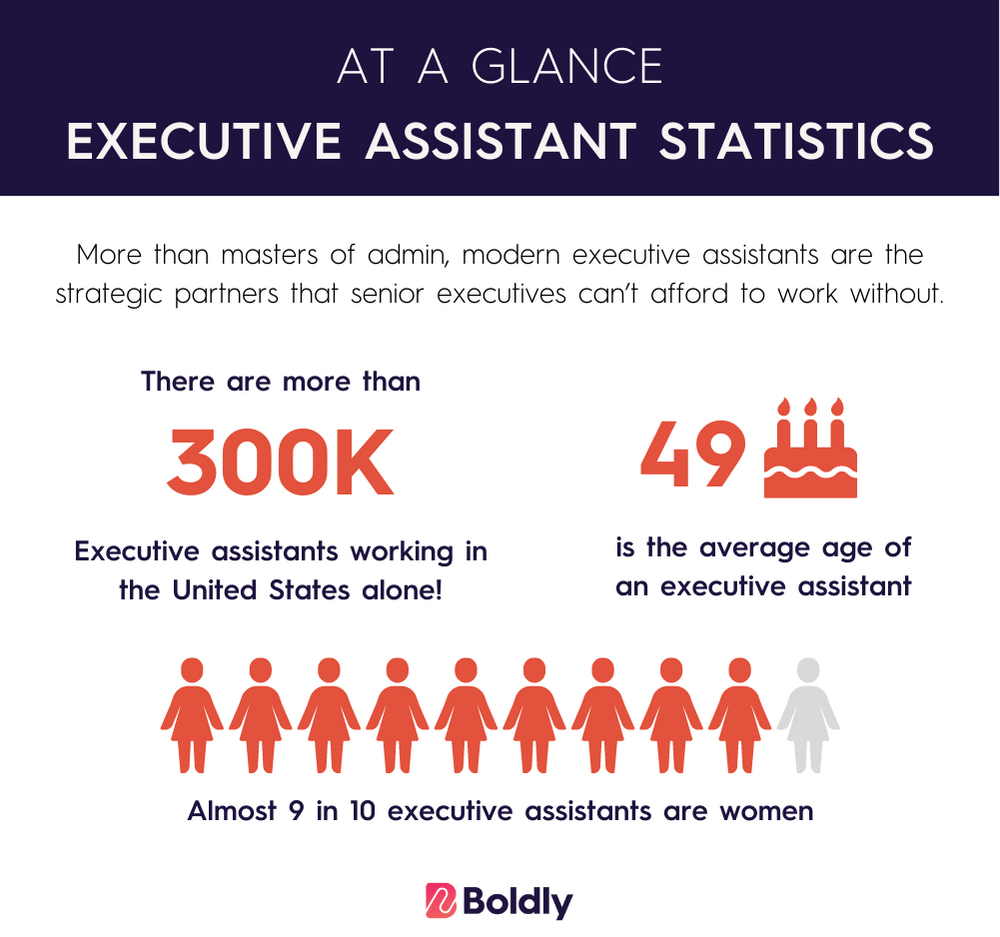
Right now, there are over 304,678 executive assistants working in the United States alone.
Most of them are women, making up almost 87% of all executive assistants.
The average age of an executive assistant is 49 years old. This means they have lots of experience, which is helpful in a business world that’s always changing, especially with recent shifts due to the pandemic.
When we look at ethnicity, most executive assistants are White (71.0%). The next biggest groups are Hispanic or Latino (11.2%), Black or African American (7.6%), and Asian (5.0%).
There’s a need for more diversity in this job to boost creativity and better problem-solving. (However, as a top inclusive workplace we’ve seen that a remote working model can actually boost diversity and inclusion!)
Today’s executive assistants are mostly experienced women who play a key role in running businesses across the United States.
What Executive Assistants Make: Compensation Trends And Growth
The role’s evolution into a strategic position is reflected in what executive assistants make today. In 2026, compensation packages are expected to grow significantly to match the expanded responsibilities and technical expertise required.
According to recent data, how much executive assistants make varies based on executive assistant level and location, with the national average base salary ranging from $35,000 to $71,000 per year. Entry-level EAs typically start in the $35,000-$45,000 range, while senior-level executive assistants with 10+ years of experience command $65,000-$104,000 or more.
Key factors influencing executive assistant pay rates in 2026 include:
- Technical proficiency with AI and automation tools
- Experience managing hybrid or remote teams
- Strategic decision-making capabilities
- Cross-functional project management expertise
- Geographic location and cost of living adjustments
The Shift To Remote Work And Tech Savviness For Executive Assistants
COVID-19 changed the way we work for good. And today, executive assistants are becoming much more technology-centric. Executive assistants are commonly required to be the command center for an entire hybrid staff.
The Boldly executive assistant role has evolved to encompass virtual team leadership, with many professionals managing distributed teams across multiple time zones.
They frequently need to know how to leverage SEO marketing, writing blog and social media content, create presentations, run virtual meetings and breakout sessions, execute surveys, manage productivity apps, and use project management software—on top of the typical scheduling, travel booking, and inbox management.
The rapid shift to remote work forced companies to adopt new technology and find ways to stay connected during quarantines.
This shift continues to pave the way for experienced women like moms, caregivers, military spouses, and more to work as high-level remote executive assistants. Plus, research from McKinsey Global Institute found that tasks with higher work-from-home potential perfectly match the role of the modern EA.
Add to this, EAs now constantly upskill to stay competitive, which puts them in solid control of their career trajectory. Virtual executive assistant training programs have become essential for career advancement, covering everything from AI tool mastery to remote team management and digital workflow optimization.
One of the primary ways EAs are boosting their tech savviness and productivity is by embracing AI. (We’ve certainly done the same at Boldly.)
In 2025, top use cases for AI among executive assistants clustered around assistive but non-critical work:
- Drafting and polishing emails
- Creating first drafts of reports and briefs
- Summarizing documents and meetings
- Brainstorming agendas, messaging, or project plans
- And more
EAs also leveraged AI for travel options research, routing and organizing calendar options, and light data analysis. This turns raw inputs into simple tables or draft dashboards before applying their own judgment for the final output.
A key pattern emerged: high-performing EAs experimented more.
Surveys of top-tier EAs showed over 90% were actively exploring where AI fit into their work, even while remaining cautious about delegating sensitive tasks like inbox management or complex event planning. Skepticism about accuracy and organizational security policies meant many still avoided using AI directly on confidential email or financial systems, instead using it as a sidecar for thinking, drafting, and research.
Looking ahead to 2026, the best EAs are becoming “power users” of AI, embedding it deeply into research synthesis, document creation, and data analysis. Instead of using AI only to draft individual emails, leading EAs are now using AI to digest long project threads and produce concise executive-ready briefs, combine customer or employee feedback into patterns, and surface risks or opportunities earlier.
This exemplifies their sharp departure from a purely administrative role. They’re being trusted to lead and manage organizational changes, too.
However, as the executive assistant role has grown in strategic importance, so have the risks to their physical and mental health.
Mapping The Future: The Expanding Role And Influence Of Executive Assistants
It’s clear that executive assistants have influence at the decision-making table.
Their future is big and bright. As the role evolves, it will bring more challenging tasks and complexities. But with that responsibility comes the chance to make an even greater difference while advancing a meaningful career.
EAs are ready to keep expanding their roles. The question for companies: are you ready to make the most of their potential?