


In 2025, an experienced, US-based executive assistant hourly rate averaged $35–60 per hour.
As we move into 2026, market trends suggest this range will likely increase by 3-5% to account for inflation and the continued demand for skilled executive support.
The Wall Street Journal profiled an executive assistant earning a jaw-dropping $400,000 per year back in 2022. Three years later in 2025, high-end EA salaries continued to climb, and as we move into 2026, top-tier executive assistants at Fortune 100 companies and major financial firms are expected to push even closer to (or beyond) that half-million dollar threshold.
In major cities a high-level executive assistant salary can reach upwards of $100,000 or more, while the national average hovers around $60,000 annually. These figures are expected to climb as remote work stabilizes and companies compete for top-tier administrative talent.
In the past, only C-suite executives had access to six-figure executive assistant support. By 2025, remote executive assistants had become the norm at corporations looking to control costs and streamline hiring. These companies discovered they could access the same quality of work and high-level experience without the overhead and commitment of a full-time, in-person staff member.
If you are simply looking to delegate one-off tasks such as data entry, answering phone calls, or handling some online research, you can get away with paying even less. There are platforms offering pools of virtual assistants that will do such work for $10/hr. The average cost of a virtual assistant can be kept surprisingly low (although that comes with some trade-offs).
So how much should you be paying?
It depends on the kind of support and how much support you’ll need. In this article, we’ll share how to:
- Calculate the ROI on an executive assistant’s salary
- Understand the six influencing factors for the salary of an executive assistant
- Make the best choice for your situation
First up, let’s talk ROI.
What ROI Should I Expect On An Executive Assistant Salary?
An easy way of calculating what you should pay for an executive assistant is by looking at ROI instead of an hourly wage. After all, a high-level trusted EA can easily increase your productivity by 15-20%.
A simple cost/benefit analysis can determine how much time you could save and the value of that time.
Here’s how to run the numbers:
- Take an honest look at your administrative workload. For 2-4 weeks, keep track of how many hours you spend each day on tasks that could be off-loaded to a trusted assistant. It isn’t uncommon for this to average 2+ hours a day.
- Estimate the value of that time. 2 hours a day adds up to 40 hours a month. That’s a full work week or 15-25% of your time spent on administrative tasks! What type of business impact would an extra week have on your bottom line or critical projects?
At a minimum, the ROI of an executive assistant would be your hourly salary x the time you spend on administrative tasks.
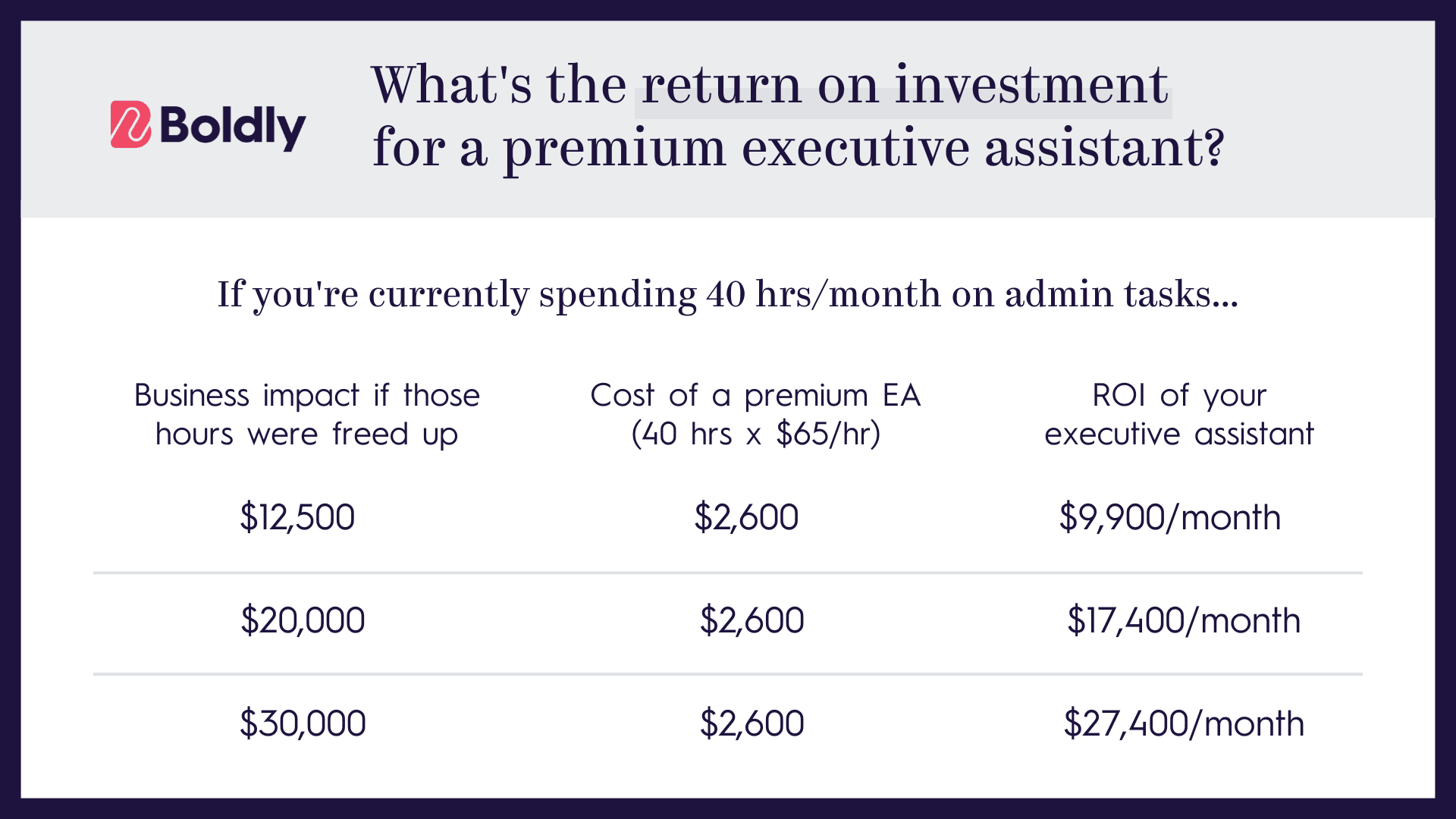
When you start to imagine what is possible with that extra time, the ROI on an executive assistant’s salary increases exponentially.
- Could you close an extra deal?
- Develop a new product line?
- Take on a strategic project that will drive growth next year?
- Make your staff more productive?
Alternatively, if you are working “insane hours,” think of the cost of an EA as an investment in your health and building a sustainable work/life balance.
If you can use that previously mentioned 15-25% of administrative time to generate $2,500 of impact each month (only $30,000 per year), spending about $2,500 each month on a high-caliber fractional executive assistant delivers a strong return on investment.
And the ROI only goes up from there.
At Boldly, we find that 2-4 hours per day is enough for a fractional EA or virtual assistant to radically shift an executive’s work.
What Factors Influence An Executive Assistant’s Salary?
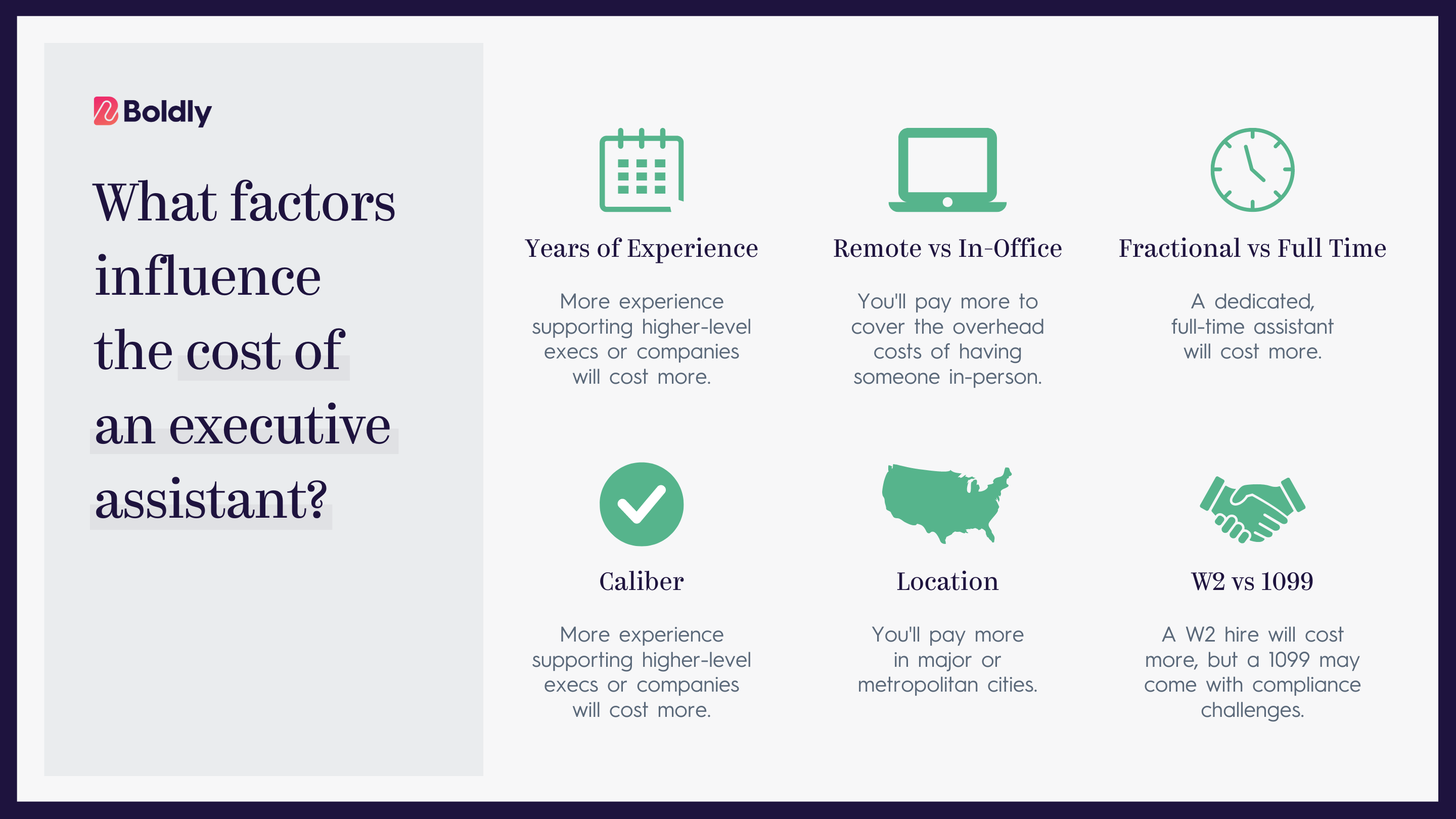
While there isn’t a one-size-fits-all rubric for determining an executive assistant’s salary, there are a number of factors that can determine the cost, including:
1. Previous Experience
Understandably, the more years of experience an executive assistant has, the more you’ll pay. Glassdoor estimates that the salary for an EA with 7-9 years of experience is 25% higher than someone in the same role with only one year of experience.
It’s also important to consider both the years of experience as well as the specific roles an EA has had.
2. Executive Level & Reporting Structure
The executive level you support significantly impacts compensation.
In 2025, an executive assistant to the CEO salary typically commanded a premium of 20-35% over assistants supporting vice presidents or directors. CEOs require EAs who can handle confidential board communications, manage C-suite calendars, and represent the company at the highest level.
As we enter 2026, this premium is expected to hold steady or potentially increase as CEO workloads become more complex and the need for strategic-level administrative partners intensifies.
3. Remote vs. In-Person
If you need an executive assistant to bring you coffee or handle other in-person tasks and you live in a high-cost market, you’ll pay a premium for an in-office EA.
An in-office employee typically costs 1.25 to 1.4 times their base salary once expenses such as taxes, benefits, equipment, and office space are calculated. Recruiting and hiring costs can even run 33% or higher than the first-year base salary.
A virtual assistant’s salary doesn’t come with those added in-person costs. Even better, there are a number of remote staffing options that connect you with a virtual executive assistant without any of those additional expenses.
4. Fractional vs. Full Time
Do you need someone for just a few hours — or will you need your remote executive assistant to be available around the clock?
A part-time or fractional executive assistant can be a more efficient use of company resources as you only pay for the time you need.
5. Caliber Of Support You Need
While this often correlates with an executive assistant’s level of experience, the more important factor here is how much you’ll need to trust your EA to represent you.
If you merely need someone to be a task manager, that will often be less expensive than finding an EA who can step in as a trusted partner.
6. Location
Executive assistants in major cities and metropolitan areas typically earn 15-24% more.
For example, according to data collected by Salary.com, the median salary of an executive assistant is $103,000 in San Jose, CA. Compare that to Norman, OK, where the cost of living is 44% lower and the median executive assistant salary is only $81,000.
7. Hiring vs. Contracting (W2 vs 1099)
Hiring a W2 employee compared to a 1099 contractor typically costs you 15-30% more.
A direct hire (W2) will almost always be more expensive, even if the employee is remote or part-time, since you’ll be required to pay for taxes, benefits, and more. In addition, you’ll be on the hook for the cost of finding, hiring, training, and retaining an EA.
Hiring a contractor can be less expensive and you aren’t locked into the commitment/costs of hiring, but it has downsides and risks — especially if you want someone for the long term.
For something in the middle, consider subscription staffing.
You’ll pay a premium hourly rate to access the long-term W2 employees of a staffing firm with the flexibility to scale up or down.
What Should You Expect For Executive Assistant Salaries In 2026?
Based on 2025 trends, here’s what we’re seeing as we move into 2026.
The competition for experienced EAs that intensified in 2025 hasn’t eased, creating upward pressure on salaries. Companies that froze wages in previous years are now playing catch-up, pushing market rates higher across the board.
The remote executive assistant model that dominated 2025 will continue to shape 2026 compensation strategies. Top remote EAs are commanding salaries closer to major-market rates regardless of where they live.
Throughout 2025, AI tools became standard in EA workflows. In 2026, the most valuable executive assistants will be those who can leverage these tools while providing the strategic thinking and relationship management that technology can’t replicate. This skill set commands a premium.
After several years of elevated turnover and expensive backfills, forward‑thinking companies are using their 2026 budgets to invest more in retention. Instead of accepting six‑figure replacement costs for senior executive assistants, they are steering higher‑than‑average raises—often in the high single digits—to their best EAs to keep them.
The bottom line? If you’re using 2025 salary data without adjustment, you’re likely underbudgeting for 2026.
What Executive Assistant Salary Range Is Right For You?
After working with hundreds of senior execs from high-growth startups to Fortune 500s to large nonprofits, making the best salary decision boils down to two questions:
- What ROI do you want to realize?
- What’s the order of importance for the 7 influencing factors above??
Once you have clarity here, you can automatically narrow your search with hard numbers and great questions to find a rockstar executive assistant this year and beyond.