


With so many different types of assistants – some with similar-sounding titles – you’re probably asking yourself: What do executive assistants do that other assistant roles don’t?
Executive assistants operate at the level of company leadership, not just around it.
Administrative assistants typically earn 30-60% less than EAs, a pay gap that maps directly to the difference in scope. One role keeps an office running, while the other keeps a company leader running. An EA manages communications, owns the calendar, prepares for high-stakes meetings, and often has a hand in how decisions get made. That’s not a task list. That’s a working partnership.
Read more: From Admin to Strategist: Top Executive Assistant Statistics
Executive Assistant Duties & Responsibilities
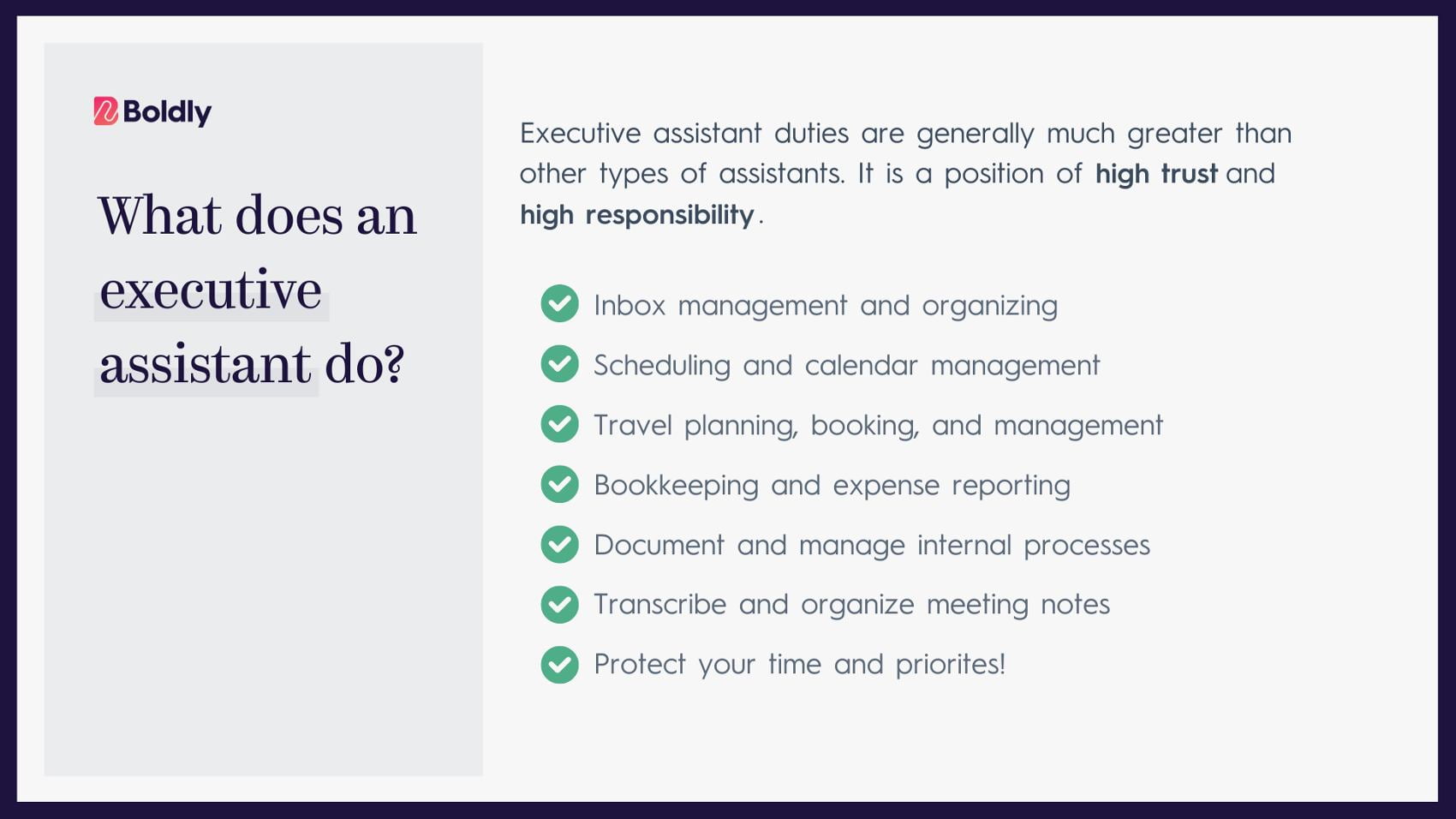
The full scope of executive assistant responsibilities is broader than most job postings let on. The list below covers the core of it, but the real work happens in the judgment calls between line items:
- Managing calendars and appointments for company leadership.
- Handling communications for company leaders, particularly in the management of email. That includes writing and responding to emails, inbox management, and sorting email. It also includes taking phone calls and passing on relevant messages to leaders in a timely and appropriate manner.
- Preparing for meetings and presentations for company leaders, including gathering all materials, handling meeting details, and making sure that everything required to make the meeting run smoothly has been taken care of.
- Planning travel for work and personal needs for company leaders, paying special attention to the preferences of each leader.
- Project or team management at an appropriate level as determined by your company.
- Managing access and archival of documents, processes, records, and proprietary information for company leaders.
- Protect your time and priorities, especially when there is a lot of pressure on your time and energy.
At first glance, this list might not seem different from what you’d expect from a list of admin assistant skills. In fact, many executive assistant responsibilities will overlap with some of the things an admin assistant might do.
But the truth is an executive assistant is not the same as an admin assistant.
An executive assistant is a position of responsibility and high trust. It’s more than having someone on your team who clears a task list. It’s having a real team member dedicated to your success and who has your back.
One way to see the difference is to ask one simple question: How does an executive assistant add value to your company?
Necessary Executive Assistant Skills
That list of responsibilities means that executive assistant skills must include a mix of both professional and personal skills in several key areas:
- Communication: An executive assistant should have the ability to adapt to different communication styles and represent the voice of the company leader they support. They should be able to communicate professionally and clearly in both written and spoken forms.
- Trustworthiness: An executive assistant should have personal ethics that make it possible for their executive to trust them, both in handling sensitive information and in reliability to see work finished.
- Knowledge: Today’s executive assistant must have capabilities working with common software, online apps, AI tools, and other planning and project management tools. Your clients may have proprietary systems they’ll be required to use. Which means…
- Adaptability: An executive assistant must have the ability to learn and adapt to different systems, tools, and work styles, and a willingness to adopt the methods that work best for you and your company.
- Emotional Intelligence: An executive assistant must be able to understand not only their executive’s personality, but also those of team members and clients so that projects and meetings go smoothly. An executive assistant must be a good match with your personality as they are going to be a main source of support.
- Experience: A history of working with executives who have high expectations and significant need for effective and efficient output is critical for an EA. While a less experienced EA still has much to offer, C-Level executive assistants should have no less than seven years experience working at that level.
Hard skills, such as knowing how to use specific software or being familiar with methods of time management, are easier to understand or measure than soft skills that involve personalities and being able to read and anticipate what a person will do.
For the executive assistant, however, both are necessary.
The Executive Assistant Job Role
The executive assistant’s work description has shifted considerably over the last few years.
An executive assistant’s most basic role is to support you in a way that makes your role more effective, efficient, and successful. What that looks like depends on your individual needs and company culture.
Remote EA roles grew 25% as companies expanded virtual operations, which means an executive based in Chicago can work with a high-performing EA located anywhere. For many companies, that’s no longer a workaround. It’s the default.
What the role looks like on any given week still depends on individual need and company structure. Not every executive requires full-time dedicated support. Some EAs are assigned to one leader; others work in a fractional capacity, shared between multiple executives who each need part-time help.
The executive assistant job role will also vary depending on the type of worker the assistant is.
Will the assistant be an employee of the company they work for, or be a freelancer or an independent contractor? Will the assistant work for a staffing agency, or as part of a pool assigned to different executives as the need arises?
The role and expectations of a dedicated executive assistant, whether hired as an employee or as a freelancer, will be very different from an agency or pool. The former allows them to be a part of the team, while the latter veers more towards task completion.
An Executive Assistant Career Trajectory
The shift to remote work didn’t just change where EAs sit, it changed who executives can hire. Geography used to be a real constraint, but now an executive in Austin can work with an EA in Boston, and neither of them loses anything in the arrangement.
That said, remote employee relationships don’t run on convenience alone. The ones that last tend to share two things:
- Genuine investment in the EA’s growth
- A personality match that holds up under pressure.
An executive who treats their EA as a task-processing machine will cycle through them. The executives who treat the role as a real professional relationship tend to keep good people.
This means that career development opportunities matter and should be a part of company culture. Executive assistant’s who have a path forward are more likely to stay and improve. Creating great career development opportunities for your EA isn’t altruism; it’s a retention strategy.
Most importantly, there must be a good match between personality and company values. This reduces conflict and increases the likelihood of an executive and their assistant having a successful working partnership for years to come.
How Is An EA Different From Other Types Of Assistants?
Understanding the nuances between various assistant roles can help you decide what type of support you need.
It’s important to note that while these roles have distinct primary functions, there can often be overlap depending on an organization’s structure and needs.
The titles might blur together, but the roles don’t function the same way. Here’s a quick breakdown:
- Administrative Assistant (AA) – Often handles routine office tasks, such as data entry, phone reception, and file management. They ensure the smooth operation of office logistics. The role is often entry-level.
- Personal Assistant (PA) – Focuses on individual tasks related to personal affairs, appointments, travel, and sometimes household management. Read more about the role of a personal assistant (PA) here.
- Virtual Assistant (VA) – Provides remote assistance across various tasks, including administrative, technical, or creative assistance, depending on the client’s requirements. Typically responsibilities more task-focused and less strategic than an executive assistant. Learn more about the difference between a virtual assistant and a remote executive assistant.
- Executive Assistant (EA) – Works closely with company leadership to manage schedules, communications, and strategic projects. They often act as a liaison and play a role in decision-making processes.
How To Hire An Executive Assistant
There’s no shortage of ways to find a rockstar EA, you can use resources like job boards, staffing agencies, referrals, or even LinkedIn.
Most of these things work eventually. But all of them require you to spend time you don’t have writing the job description, screening applications, running interviews, checking references, and still ending up with someone who needs months to ramp up.
If you’d rather skip that part, learn more about how Boldly works and get a vetted, experienced EA matched to you without the hiring process.