


A C-suite executive assistant protects a leader’s time by deciding what gets onto the calendar at all. The EA screens meeting requests, blocks uninterrupted hours for high-value projects, and takes over inbox triage and project follow-up. They also protect evenings and vacations. The need is real: Forbes reports that executives spend close to 23 hours a week in meetings, and UC Irvine researcher Gloria Mark found it takes about 23 minutes to get back on task after an interruption. If an EA saves you two hours a day and your time is worth $250 an hour, that comes to roughly $10,000 a month.
Your time is finite. Your energy is limited.
But your potential? That’s unlimited when you have the right support.
And there’s no one more effective at supporting leaders than a premium, C-suite executive assistant.
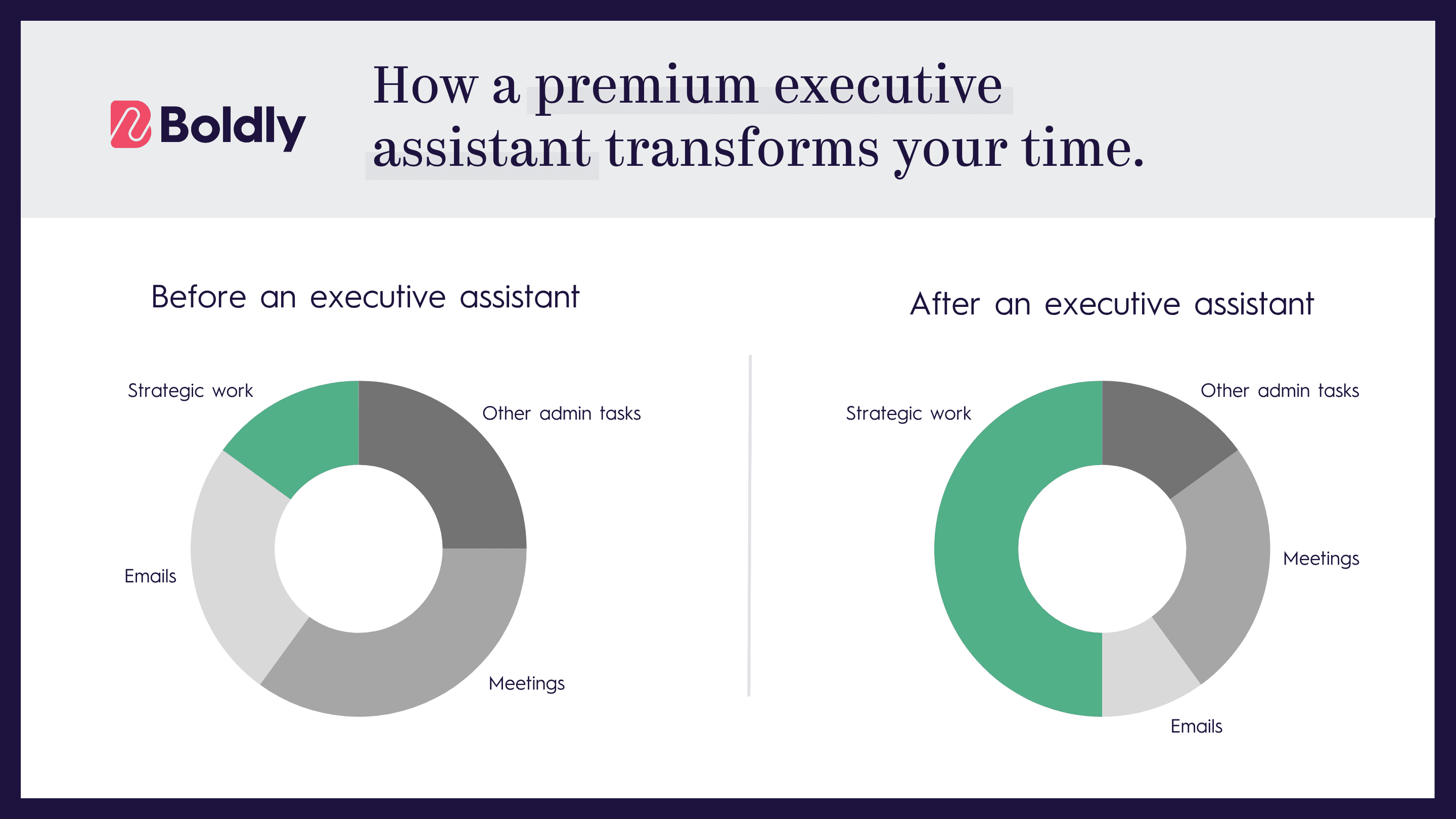
Here are 10 ways an EA can transform how you spend your day.
1. EAs Build Executive Time Management Around Your Priorities
Your EA doesn’t just manage your calendar. They become the strategic architect of your time.
Executives often overestimate the time they spend on priorities and underestimate the hours spent on administrative tasks. Closing that gap is the real work of executive time management, and it’s where your EA becomes invaluable.
- Your EA learns what energizes you.
- Your EA knows what drains you.
- Your EA knows all the little things it takes to move your business forward.
They understand that your 9 AM Tuesday slot should be for deep strategic work, not back-to-back meetings. They know when you need buffer time between presentations. They know you must leave by 6 PM for your daughter’s soccer game.
More than scheduling, this is strategic life design. Your EA makes sure your calendar reflects your values and priorities, not simply the latest fire.
2. EAs Block Time Vampires & Distracting Tasks
The practice of leading has changed.
Forbes reports that executives now spend nearly 23 hours a week in meetings. This is a sharp increase from less than 10 hours in the 1960s. Many of these meetings lack clear objectives or outcomes, leading to frustration and a significant drain on time and focus.
Your EA becomes the ultimate gatekeeper. They ask the tough questions: “What’s the agenda? Who needs to be there? Can this be handled via email instead?”
They’re not just saying “no” to protect your time. They’re saying “yes” to your highest priorities.
When someone wants to pick your brain for 30 minutes, your EA can often handle the request. This leaves your brain-picking time for strategic conversations.
3. EAs Block Time For Career-Changing Projects
Remember that project sitting on your desk? The one you never have time for because urgent tasks keep crowding it out?
Your EA has access to the big picture. With your input, they understand which projects can transform your career. They make sure those projects get protected time blocks on your calendar.
- No interruptions.
- No “quick questions.”
- No emergency meetings during your innovation hours.
This time-blocking ensures your most important work doesn’t get buried under daily demands. Your EA guards your long-term success as well as your short-term productivity.
The need for that protection is sharper than ever. Microsoft’s 2025 Work Trend Index found that employees are interrupted roughly every two minutes during core working hours by a meeting, email, or ping—which is why the uninterrupted stretches a big project actually requires almost never happen on their own. Someone has to carve them out and defend them.
4. EAs Solve Travel Problems Fast
Plane delayed? Connection cancelled? Hotel overbooked? While you focus on your upcoming presentation, your EA is already finding solutions.
Adaptability and scenario planning are mission-critical.
A skilled EA can:
- anticipate conflicts
- use scenario planning
- master digital tools to successfully resolve complex scheduling issues
These skills have become even more vital as remote and hybrid work models introduce new scheduling challenges.
They can track flight changes, create a backup plan, and find an alternative if something falls through. You arrive calm and prepared while they handle the chaos.
5. EAs Handle Your Endless To-Do List
That one thing that’s been on your to-do list for months? Hand it to your EA.
Executives spend 57% of their time on meetings, emails, or chats, leaving only 43% for core job tasks. Your EA can flip this ratio by taking on time-consuming but necessary tasks that don’t require your expertise.
Your EA can:
- research market trends
- compile competitive analyses
- organize your digital files
- coordinate with vendors
- manage project timelines
- and more!
This frees you to focus on strategic thinking, relationship building, and decision-making that only you can do.
6. EAs Provide Strategic Project Management
EAs don’t just manage tasks. They help manage the projects that could make or break your year.
You know that major initiative you’ve been talking about for months? The one that keeps getting pushed back because no one has time to actually make it happen? Hand it over.
A skilled EA becomes your project quarterback. They coordinate between departments, chase down the people who haven’t responded to emails, and keep everything moving when you’re pulled into other priorities. They handle the messy details so you can focus on the big picture.
They also know which projects are worth prioritizing and which ones are just busy work. While you’re focused on strategy, they’re making sure things actually get done.
This is how your brilliant ideas stop living in meeting rooms and start delivering real business results.
The cost of leaving projects unmanaged is well documented. The Project Management Institute found that organizations waste an average of 11.4% of every dollar they invest in projects because of poor project performance. An EA acting as project quarterback—chasing owners, holding timelines, keeping work moving — is how you keep your initiatives out of that wasted share.
7. EAs Spot & Stop Time-Wasting Patterns Before They Drain Your Day
The best EA’s are proactive in finding early warning signs of scheduling and communication breakdown. They will address minor conflicts before they become major disruptions.
Your EA becomes an expert at this, catching patterns that steal your time.
When you’re consistently double-booked on Thursdays. When certain types of meetings always run 20 minutes over. When specific people or requests consistently derail your focused work time. Then they take action.
Your EA doesn’t just observe these patterns.
They fix them by:
- restructuring your calendar flow
- establishing boundaries with chronic busywork
- creating systems that protect your most productive hours
Your EA becomes a time detective, constantly scanning for threats to your productivity and removing them before they impact your day.
Those patterns are worth hunting down because interruptions are expensive. UC Irvine researcher Gloria Mark found that once a knowledge worker is pulled off task, it takes an average of 23 minutes and 15 seconds to fully return to the original work. A handful of avoidable interruptions a day quietly erases hours—which is exactly the leakage a vigilant EA plugs.
8. EAs Handle Communication and Email Management
Remember those 3.4 hours per week that executives waste on worthless emails? Your EA can cut this drain on your time and attention.
They can manage your inbox by using AI tools to sort emails, respond to routine questions, flag urgent items, and draft responses for your approval
They know which communications need your personal attention and which can be handled by someone else.
Your EA can also manage your communication preferences. They ensure you’re only in meetings where your input is truly needed. They keep you informed without overwhelming you.
9. EAs Create Systems That Grow With Your Success
As your responsibilities grow and your influence expands, your EA grows with you. They create systems for managing your increasing demands rather than just working harder.
This might mean:
- using new project management tools
- creating delegation frameworks
- establishing communication protocols
- or building relationships with other team members who can support your priorities.
Your EA doesn’t just manage your current workload. They anticipate and prepare for your future success.
10. EAs Protect Your Personal Time
Your EA understands that protecting your personal time is necessary for you to perform at your best. They can ensure that work doesn’t bleed into every corner of your life, so you have time for the relationships and activities that recharge you.
In uncertain environments, like company mergers, EAs identify potential disruptions to workflow. They will develop plans to make sure operations keep moving forward.
This approach to risk management allows you to navigate change while maintaining your well-being.
They might block off your evenings for family time, make sure you have lunch breaks for actual eating, or protect your vacation time. Your EA recognizes that taking care of yourself isn’t selfish. It’s strategic.
Leaders feel the lack of that protection acutely. In a Deloitte and Workplace Intelligence study of C-suite executives, 73% said their job doesn’t let them take time off and disconnect, and nearly 70% were seriously considering leaving for a role that would better support their well-being. An EA who guards your evenings, meals, and vacation time is addressing one of the biggest threats to executive retention—your own burnout.
Why Supporting C-Level Executives Takes a Different Kind of EA
A C-suite calendar is a different animal from a manager’s calendar.
In a single week, a CEO might have board prep, an investor call that gets moved twice, a sensitive conversation with HR and a keynote three time zones away. At that level, one dropped follow-up or a double-booked hour can cost you a deal or a relationship you spent years building.
An EA with real experience supporting C-level executives has lived through enough of those weeks to know where things usually go wrong. They can tell an investor email that needs a reply before lunch from one that can wait until Friday. They also handle confidential information with discretion, and nobody has to remind them.
You can’t teach that kind of judgment in a two-week onboarding. It comes from years of working next to senior leaders, so finding the right match matters as much as any skill on a résumé.
The stakes behind that judgment are real. In the landmark “What Do CEOs Do?” study, researchers Bandiera, Prat, and Sadun found that CEOs spend roughly 85% of their time with other people, and that how they allocate those hours is measurably linked to their firm’s productivity. When a leader’s time is that scarce and consequential, an assistant who knows which hour is worth protecting is doing strategic work, not clerical work.
How Can an Executive Assistant Transform Your Leadership?
Your time and energy are your most finite resources. An exceptional EA doesn’t just save you time. They strategically invest your time in the activities that create the most value for your business and your life.
When you save 2 hours per day through effective EA support, and your time is valued at $250/hour, that’s $10,000/month in value created. And that’s just quick napkin math! The real number is likely much higher.
However, the real return goes beyond dollars. It’s measured in strategic breakthroughs, sustainable success, and the ability to show up as your best self in every area of your life.
Ready to protect your most valuable resource? The perfect EA match could be the game-changer that elevates your leadership to the next level.