


If you’re like many executives, you might think hiring “administrative support” and hiring a high-level executive assistant are basically the same thing.
They both handle your calendar. They both manage emails and book travel. So what’s the real difference?
Here’s the truth: thinking administrative work is equivalent to what a high-level EA does is like thinking an accountant is the same as a CFO because they both work with numbers.
The distinction matters more than you realize, and it’s costing executives valuable time, energy, and bandwidth.
Let’s clear up the confusion.
What Entry-Level Administrative Assistants Do
Entry-level administrative assistants play an important role in keeping offices running smoothly. They run many of the day-to-day operations and handle tasks that keep information flowing and the workplace organized.
Here’s what fills a typical administrative assistant’s day:
- Front desk communications
- Coordinating staff calenders
- Keeping track of documents and imputing data
- Office operations Financial and HR-related support
A typical administrative assistant spends about 60-75% of their day on these classic coordination tasks. Another 15-25% goes toward higher-value support like drafting complex communications or helping with small projects. The remaining time is lost to context switching, ad-hoc interruptions, and unexpected issues that pop up during the workday.
These are important, necessary functions. Offices need this work done.
But if you’re a senior executive expecting this level of support to free up your time for strategic thinking, you might be disappointed.
The Hidden Cost Of Confusing Admin Work With EA Work
When executives hire administrative support thinking they’re going to get executive assistant capabilities, inefficiency might reveal itself.
The executive is still triaging their own inbox. They’re still reworking their calendar when conflicts arise. They’re still owning follow-up on critical initiatives because no one else has the context or authority to drive those forward.
The administrative assistant is doing exactly what they were hired to do, completing tasks as requested. But the executive is frustrated because they’re not getting the strategic leverage they expected.
This isn’t anyone’s fault. It’s a misunderstanding of what each role is designed to deliver.
Administrative assistants handle tasks. High-level executive assistants handle outcomes.
What High-Level Executive Assistants Do
A high-level executive assistant operates on an entirely different plane. Yes, they do administrative work, but that’s just the start. It’s what they build on top of that foundation that creates real value.
High-level EAs are strategic partners who understand your business, not just your calendar.
They make judgment calls all day long. Which emails need immediate attention and which can wait. When to interrupt a meeting for an urgent call and when to hold all messages. When their executive is overloaded and needs a buffer from additional demands.
They’re mind readers in the best sense. A great EA works so well with their executive, observing patterns and learning preferences, that they anticipate needs before they arise. They’re prepared with information before being asked. They plan for likely contingencies without being told.
They understand context in ways that matter. The same email from two different people might have entirely different urgency levels. An EA understands office politics, relationships, and priorities well enough to make the right call.
They’re archivists with institutional memory. At any moment, they can locate critical information from past communications, client interactions, or company data. They know where things are and why they matter.
Here’s a real example that illustrates the difference:
Let’s say you need to schedule a meeting with five senior executives, all with extremely busy schedules. An administrative assistant will look at available time slots and send out a meeting invite.
A high-level executive assistant will do something completely different.
They’ll consider who the power players are and who gets first dibs on suggesting a time. They’ll think about the relationships between invitees and adjust the tone of the invitation accordingly. They’ll look at what’s already on each person’s calendar and schedule around those priorities strategically. They’ll factor in travel time between meetings and have a backup plan ready when (not if) the meeting needs to be rescheduled.
As Hollie Swofford, Boldly’s Director of Team Operations, explains: “Executive assistants are generally caretakers. They get a lot of energy in their work from making the lives of other people easier, more organized, really showcasing a lot of care for their executives behind the scenes so that their executives can focus on meaningful work to move the organization forward.”
You can hear more from Hollie about what makes executive assistants exceptional in this conversation with our Recruitment Manager.
The Strategic Shift That Happens With A High-Level EA
When an executive doesn’t have a high-level EA, they are their own assistant. They’re doing all the high-value work an EA should be doing, plus trying to run the company.
That should tell you something important about the nature of EA work. It’s not just administrative. It’s strategic, complex, and requires significant judgment.
When the right EA steps in, a noticeable shift should happen for the executive. Tasks and decisions that were consuming mental bandwidth simply disappear from their plate. They’re not just checking things off a list faster. They’re operating at a completely different level.
With High-Level EA support:
- The executive’s focus moves from logistics to strategy. Instead of spending a large amount of time triaging email and reworking calendars, they’re thinking about quarterly priorities and long-term growth.
- Decisions get made faster. The EA handles everything that doesn’t require the executive’s specific expertise or authority, dramatically reducing decision fatigue.
- The executive’s reach expands. A great EA acts as a force multiplier, representing the executive effectively in certain situations and managing relationships that would otherwise fall through the cracks.
- Priorities stay protected. The EA serves as a strategic gatekeeper, ensuring the executive’s time and energy go toward what matters most rather than what’s merely urgent.
This is why high-level EAs command significantly different compensation than administrative assistants. An administrative assistant earns around the mid-$40,000 range annually. A high-level executive assistant often earns in the mid-$60,000 range and can reach $80,000 to $90,000 or more when supporting senior leadership.
At the very top level, EAs supporting CEOs or operating in Chief of Staff-type roles can earn well into six figures. That roughly 45% or more pay difference reflects the expanded scope, strategic thinking, and business impact these roles deliver.
With Boldly’s subscription-based staffing model, you can access this level of premium executive assistant support for just the hours you need. You get highly qualified, personally matched remote talent without any of the hassles of recruiting and employment, and at lower cost than traditional hiring.
Read more: Fractional Executive Assistants: An Efficient Way To Boost Exec Productivity
The Career Path Shows The Difference
The journey from administrative assistant to high-level executive assistant typically takes five to ten years of progressive experience. That timeline alone should tell you these aren’t interchangeable roles.
Here’s what that progression usually looks like:
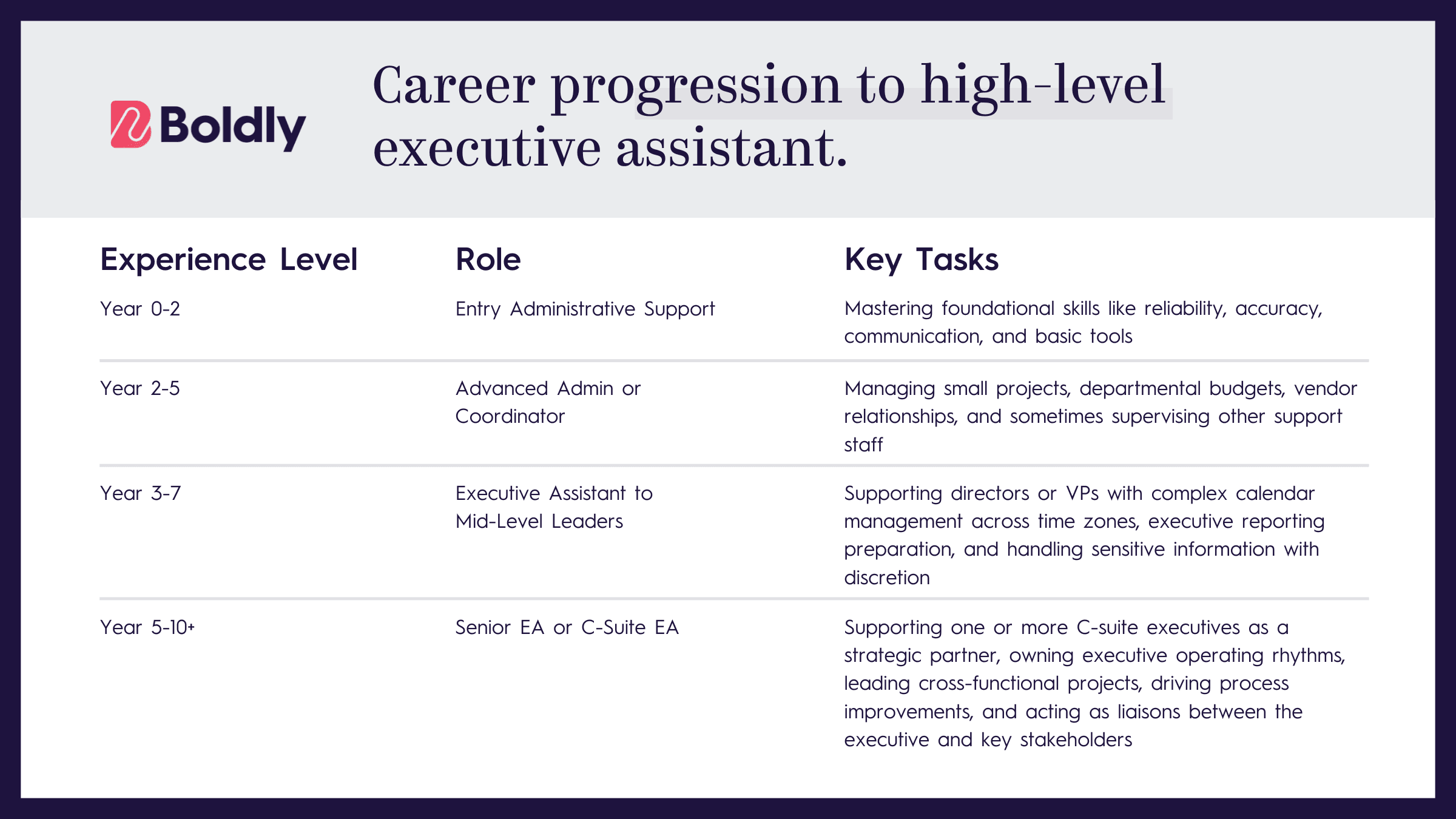
Each stage builds on the last, developing judgment, good business judgement, and strategic thinking that simply can’t be rushed.
What To Look For In A High-Level EA
If you’re ready to hire high-level support, here are the capabilities that matter:
- Experience supporting senior leadership. Look for candidates with Fortune 500 or C-suite experience who understand how executives operate at the highest levels.
- Proactive problem-solving ability. The best EAs anticipate needs and take initiative rather than always waiting to be told what to do.
- Strong business judgement. They should understand your industry, competitive landscape, and business model well enough to make smart decisions independently.
- Emotional intelligence. They read people well, navigate office politics skillfully, and adjust their approach based on the situation and personalities involved.
- Adaptability and composure under pressure. Things change fast at the executive level. Your EA needs to shift gears quickly without getting flustered.
These capabilities develop over years of experience. They’re not something you can train in a few weeks.
This is why at Boldly, we only hire executive assistants with significant experience supporting senior leaders. When we receive tens of thousands of job applications, we only select the most experienced candidates with Fortune 500 or C-suite backgrounds. Our vetting process is rigorous because we understand the difference between administrative work and high-level EA capabilities.
Administrative Work Vs. High-Level EA Work: The Bottom Line
Here’s what it comes down to.
Administrative assistants keep the office running. High-level executive assistants keep executives operating at their highest level.
Administrative work is about completing tasks. EA work is about creating leverage.
Administrative support is reactive. EA support is proactive and strategic.
Both roles are valuable. Both require skill and dedication. But they’re not equivalent, and treating them as if they are means you’re not getting the support you actually need.
If you’re a senior executive still handling your own calendar conflicts, triaging your email at midnight, and following up on initiatives that should be moving forward without you, you don’t have the level of support your role requires.
You need a partner who understands your business, anticipates your needs, makes smart decisions independently, and frees you up to focus on what only you can do.
That’s what a high-level executive assistant delivers.
At Boldly, we specialize in providing exactly this level of support. Our subscription staffing model means you only pay for what you need and can adjust hours as required. You get quick startup time without a lengthy hiring process, support from our team to ensure everything runs smoothly, and no concerns about compliance since our EAs are our employees.
Ready to experience the difference a high-level executive assistant makes? Contact us. We’d love to talk to you.