


In the high-stakes world of executive leadership, the relationship between an executive and their EA is pivotal to success.
In fact, success goes far beyond admin support — leaders need a true partner who can “take the big ideas you’re trying to operationalize and run with them.”
That’s the picture of today’s high-level executive assistant.
And it’s no surprise that productivity can increase by at least 30% when you and your EA collaborate effectively. So how do you get there?
We asked a few members of the Boldly team what they wish more executives knew.
Here’s what they said.
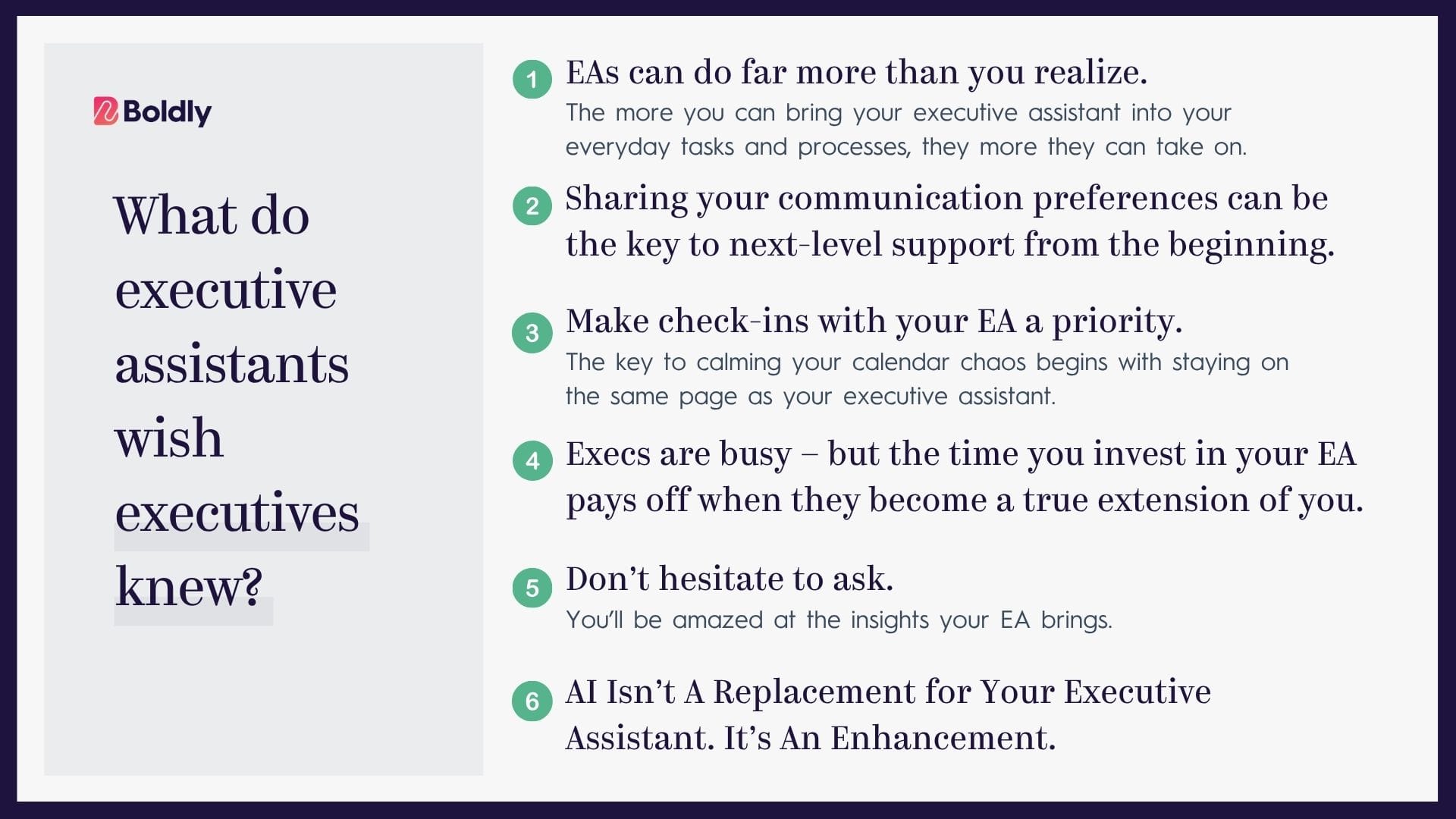
1. Executive assistants can do far more than you realize.
An executive assistant job description seems simple enough on paper.
But if you’ve ever worked with an assistant — or even with someone else’s assistant — you know it’s closer to advanced wizardry in practice.
Behind the scenes, EAs are juggling multiple priorities, deconflicting deadlines, and untangling overbooked schedules for multiple executives without missing a beat.
Even still, the more you can bring your executive assistant into your world and workload, the more you’ll realize how much they’re truly capable of. Experienced executive assistants are masterminds at finding opportunities in both the big picture and the day-to-day details.
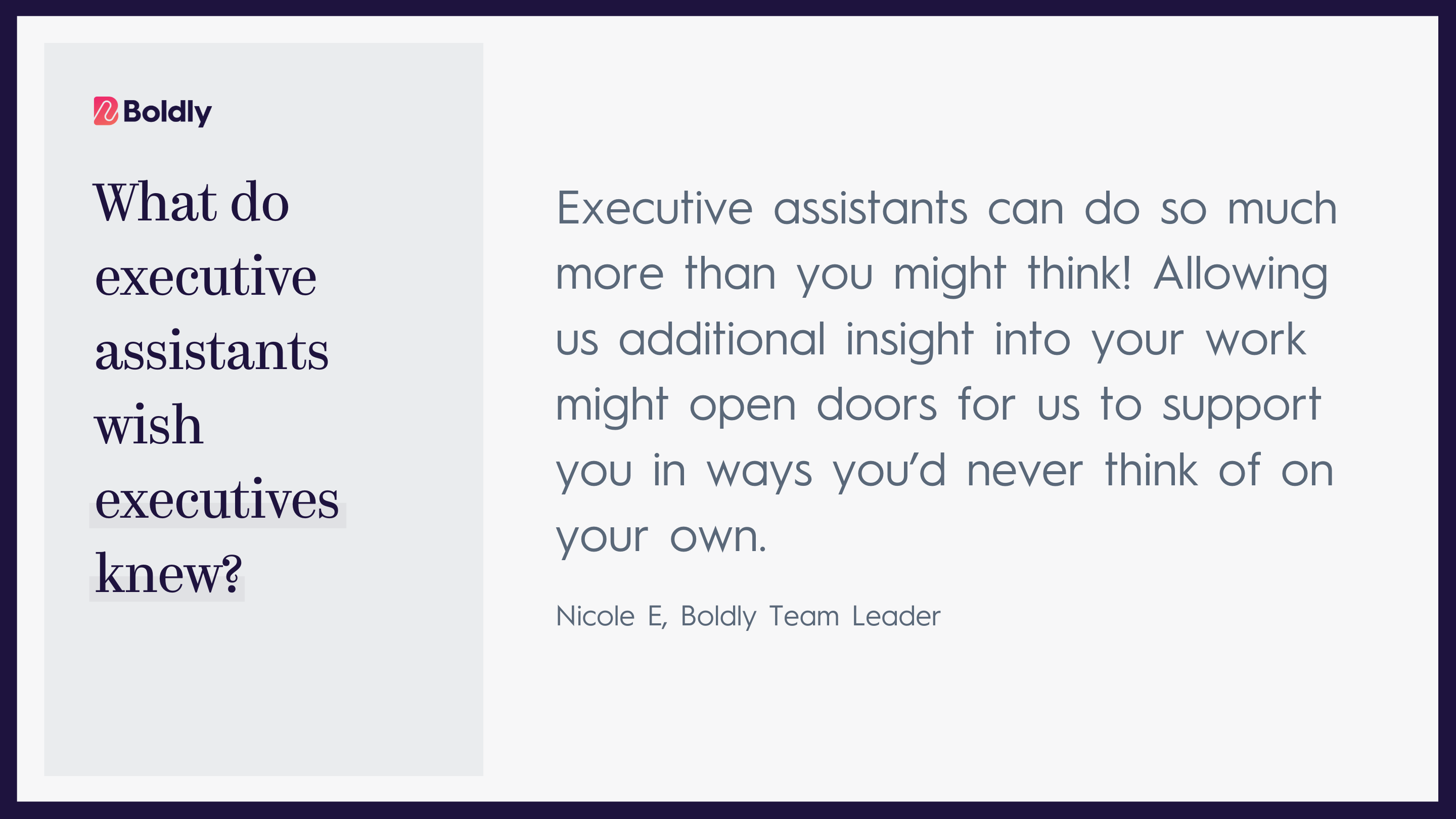
By providing your EA with a broader view of your work, you’re not just delegating tasks – you’re inviting innovation and proactive support.
There’s data behind that instinct. Microsoft’s Work Trend Index found that employees now spend roughly 60% of their time on communication and coordination — email, chats, and meetings — and only about 40% actually creating. A capable EA is built to absorb that coordination load, which is exactly why the more of it you hand over, the more of their range you see.
2. Investing Time In Your Executive Assistant Pays Off
Building on the skills and expertise of an executive assistant, another Boldly Team Member notes that executives need to know that investing in your EA is the secret to being in multiple places at once.
Leaders are incredibly busy, but the more you can take the time to build trust with your executive assistant, the more your EA can anticipate your needs and act as an extension of you.
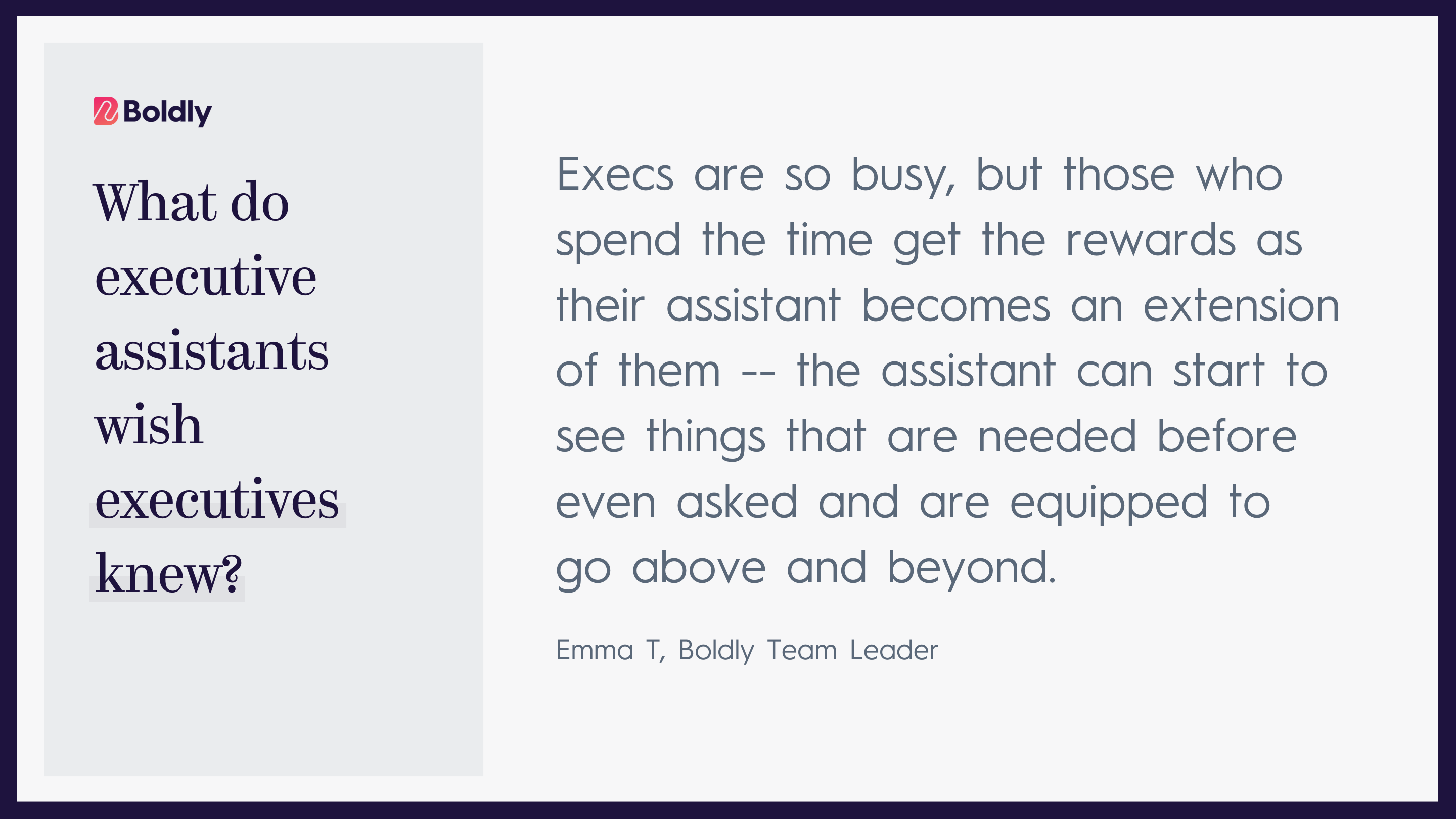
While the last thing you’re looking for is another meeting or task on your to-do list, even consistent, small investments in your EA will compound over time and transform your workday.
By investing time in your relationship with your EA, you’re cultivating a partnership that can anticipate your needs and exceed your expectations.
The payoff is well documented. In Gallup’s study of Inc. 500 CEOs, those with strong delegation skills generated 33% more revenue and grew far faster than peers who tried to hold on to everything — yet only about one in four leaders delegates well. Investing in your EA is how you join the first group instead of the second.
3. Your Executive Assistant Wants To Know Your Communication Style
Understanding your preferred communication style is crucial for an executive assistant to provide top-notch support.
- Do you feel more comfortable with daily check-ins or is a weekly round-up acceptable?
- What type of things do you want your assistant to confirm with you before moving forward?
- Are there any meetings or emails that you prefer to handle yourself?
It can be helpful to think of previous experiences you’ve had with assistants (positive or negative) and share those as well.
If you’re unsure about your communication preferences, don’t worry! An experienced executive assistant will start looking for all of these on day one and begin documenting them — they may even ask you directly!
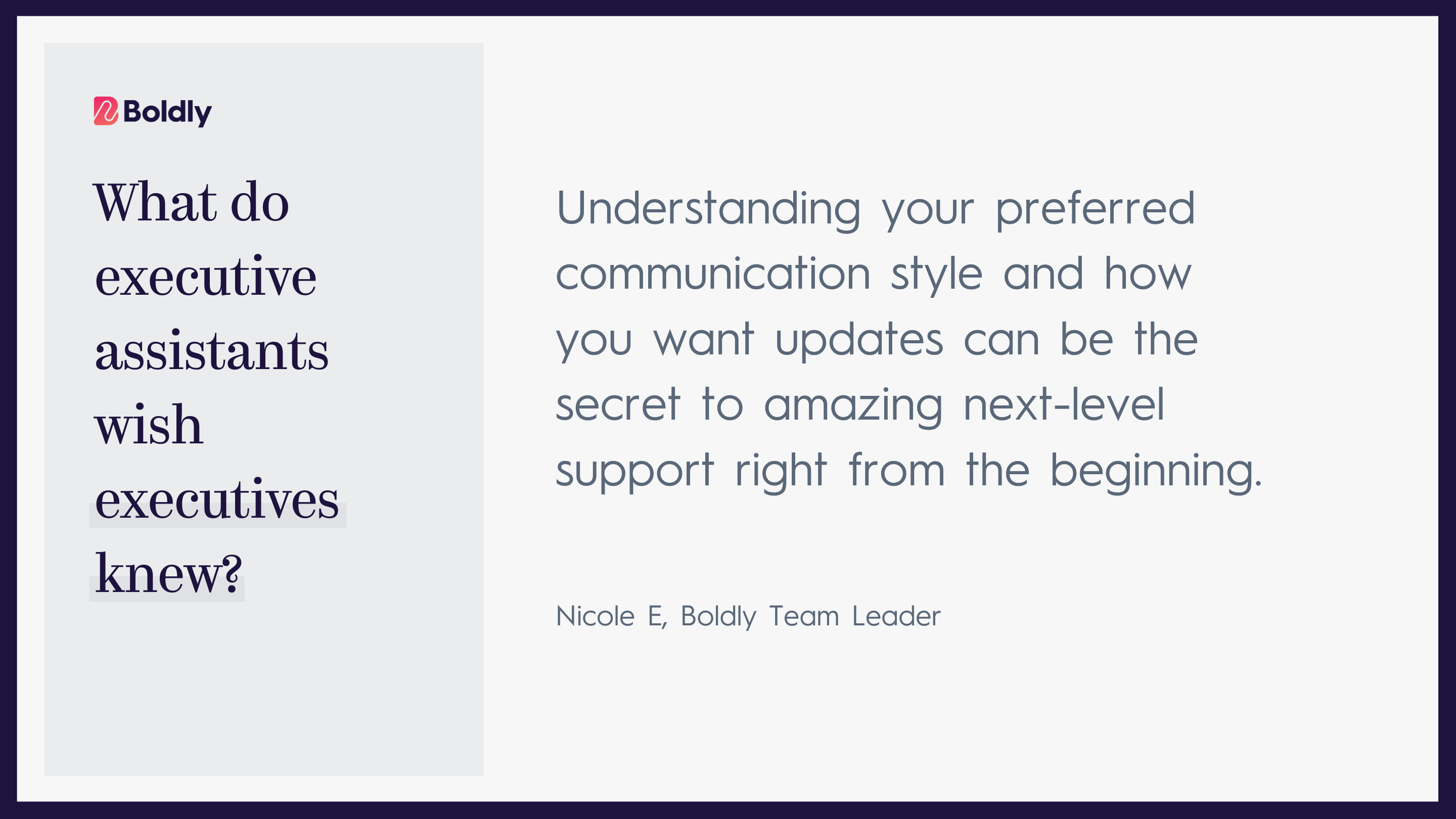
Clear and consistent communication from executives helps EAs prioritize tasks effectively and avoid misunderstandings.
Providing detailed instructions and feedback on tasks and projects is crucial. Consider setting up a system for task prioritization and regular check-ins to ensure you’re both on the same page.
A well-defined job description and scope of responsibilities can help executive assistants manage their tasks more efficiently, especially if you’re sharing an executive assistant.
Having clarity about this at the beginning can prevent role overlap and communication issues. Take the time to review and update your EA’s job description regularly, ensuring it accurately reflects their evolving role and responsibilities!
4. The Value of Regular Check-Ins
It might be easy to overlook regular check-ins when you have a whirlwind schedule and a great executive assistant.
When you’re first starting out with your EA, it’s easy to make time to invest in them and share your communication preferences. But once you’ve found a good working groove, it can be easy to shuffle these down on the priority list.
However, our team stresses the value of these meetings.
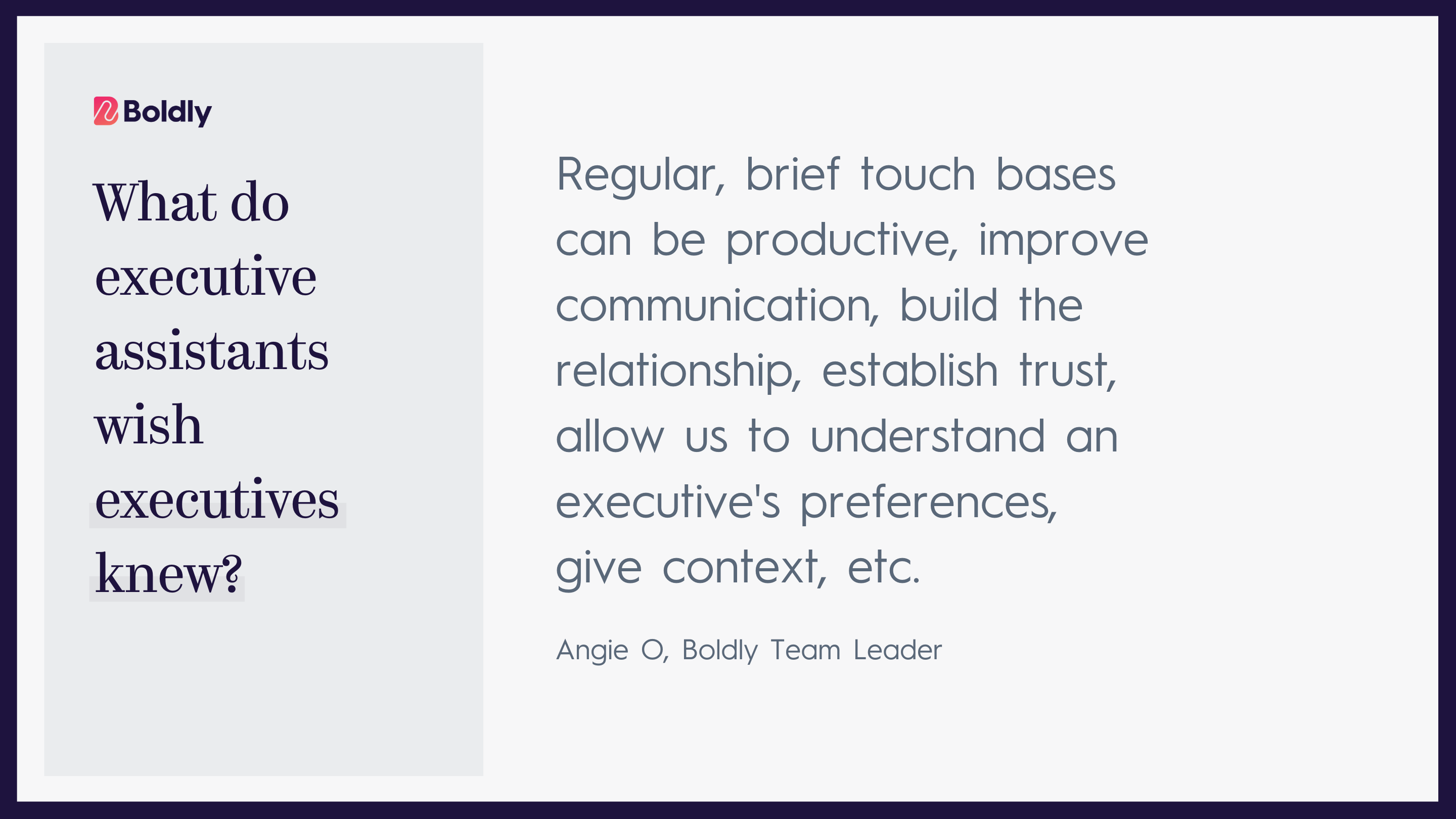
They don’t have to be long or structured, but regular touch-base meetings with your executive assistant are the key to staying on the same page — and continuing to build trust, efficiency, and productivity for you both.
The research is emphatic here. Gallup found that employees who have regular one-on-ones with their manager are almost three times as likely to be engaged as those who don’t, and engagement climbs highest when there’s some form of daily contact. A standing fifteen-minute touch-base does more for the partnership than its size suggests.
5. If You’re Wondering… Don’t Hesitate To Ask Your Executive Assistant
- Would your EA want to take on this new task?
- Do they have the bandwidth to add this in?
- Have they done something like this before?
- Are they still working on that project you mentioned last week?
- Would they like to attend a company training?
Your executive assistant doesn’t ever want you to feel left in the dark — and they’re usually eager to jump in on any task or opportunity.
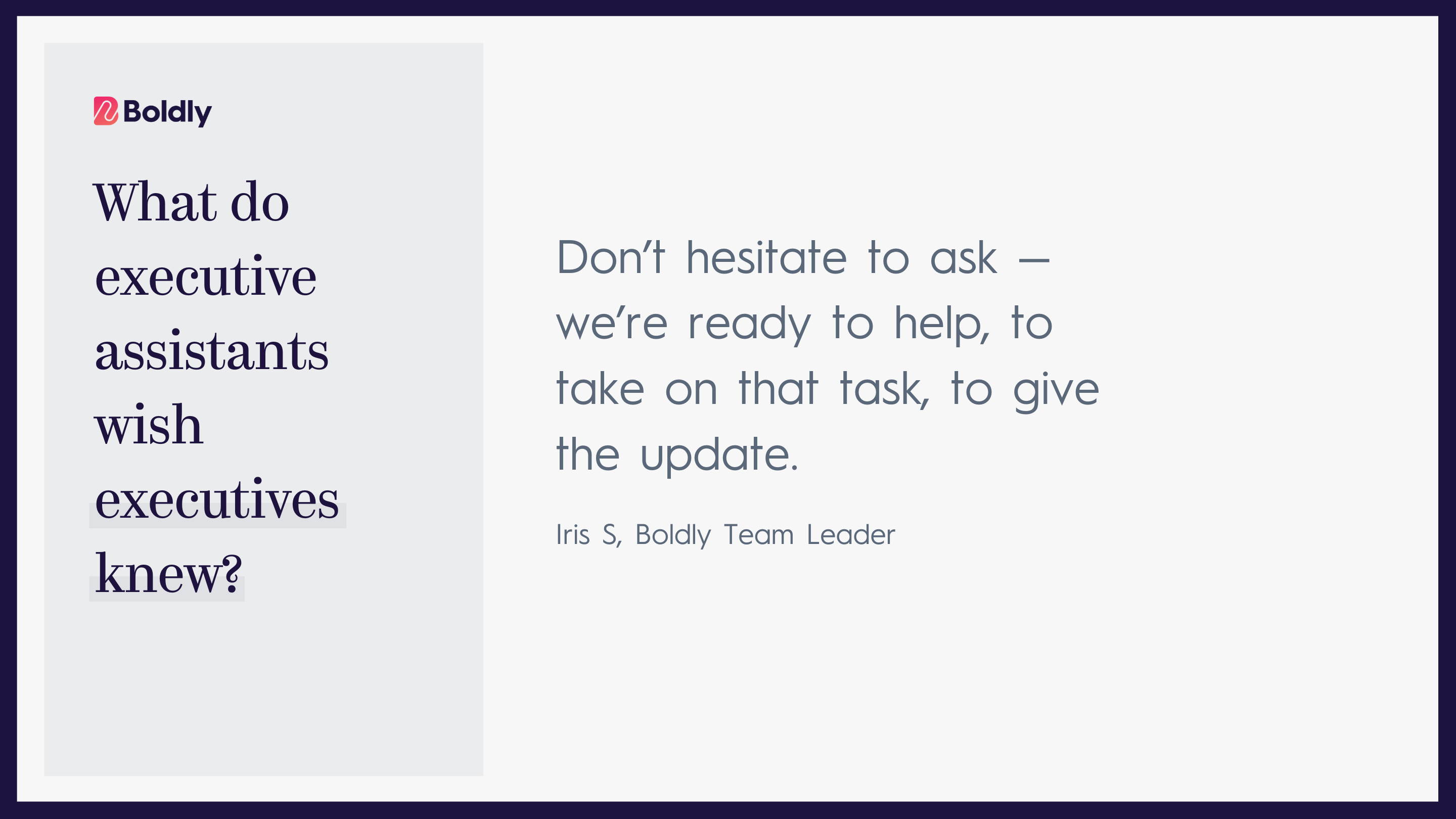
Whatever it is, go ahead and ask!
6. AI Isn’t A Replacement for Your Executive Assistant. It’s An Enhancement.
There’s plenty of noise right now about AI taking over the assistant’s job. The executives who work with our team see it differently — and so do our EAs.
Here’s what AI can’t do: read the room, catch what you didn’t say out loud, or make a smart call on your behalf when a plan falls apart an hour before your flight.
What AI can do is draft, summarize, transcribe, and dig up information in seconds. Put those two together, and you get something more powerful — a real person who already knows your priorities, now backed by tools that clear the repetitive work off their plate. Your EA can spend less time on repetitive work and more time thinking ahead, solving problems, anticipating needs, and making your life easier.
The evidence lands on the EAs’ side of that debate. Around 41% of workers worry AI could make part or all of their job obsolete (APA), yet study after study points to augmentation over replacement — Stanford’s Erik Brynjolfsson and colleagues found that pairing people with AI lifted both productivity and retention. And the time saved is real: a Federal Reserve Bank of St. Louis analysis found workers using generative AI save about 2.2 hours a week.
For an EA, those aren’t just hours saved. They’re hours that can be reinvested in judgment, problem-solving, and the work that actually requires a human who knows you.
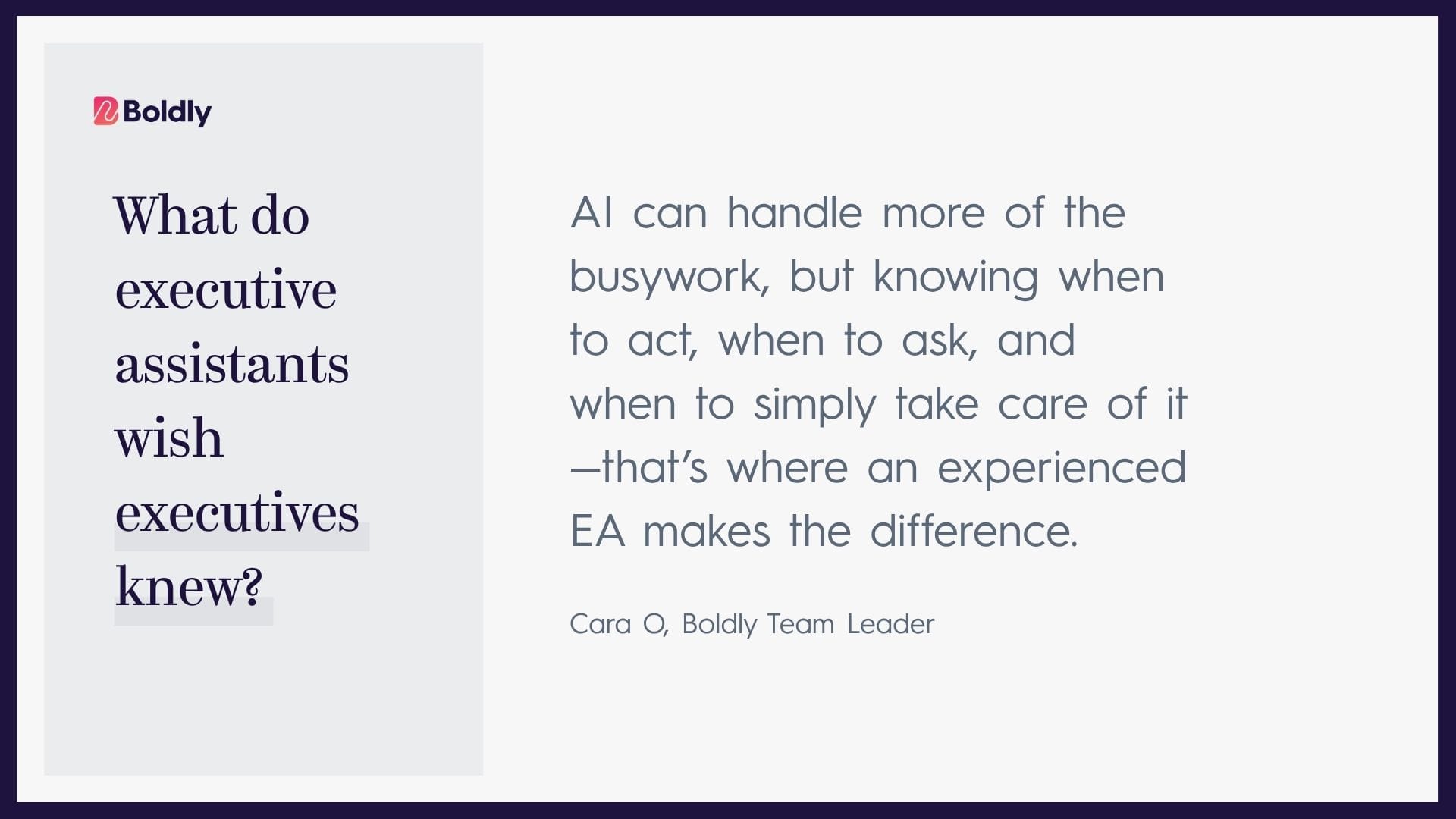
So the better question isn’t whether AI will replace your assistant. It’s how your assistant can put AI to work for you — and the answer is usually “in more ways than you’d guess.”
The Power Of A Premium Match
Lastly, your executive assistant wants you to know that executive productivity begins with the perfect match.
Boldly EAs say over and over again how much they love working with Boldly’s clients — and it’s not by accident.
We put incredible time and care into finding the “win-win” by matching our employees and our clients on a professional and personal level. We take into account skills and experience, as well as communication styles, work preferences, and personality fit to ensure everyone is happy.
Ready to experience the transformative power of a perfectly matched executive assistant?
Boldly is here to help. Our unique approach to matching executives with premium executive assistants ensures that you’ll find the ideal partner to support your success.